7 min read
The Marketing Consequences of Conway's Law
My observations of Conway's law in marketing based on 15+ years of work in marketing teams, operating in different conditions in companies of a size from 2 to 3000+ employees.
Conway's Law in Marketing
"Organizations design systems that mirror their communication structures."
This idea is known as Conway's Law, introduced by computer scientist Melvin Conway in 1967. Originally, Conway described how software systems inevitably reflect the organizational structures of the teams that build them. In other words: communication structure becomes product structure.
The concept is usually discussed in engineering and software architecture. But based on my experience in marketing, Conway's Law applies to marketing just as directly and sometimes even more visibly.
For the first several years of my career, I wasn't consciously aware of it at all. But once I started seeing it, I couldn't stop noticing it everywhere.
Implications
1. Conway's Law in Multi-Product Marketing
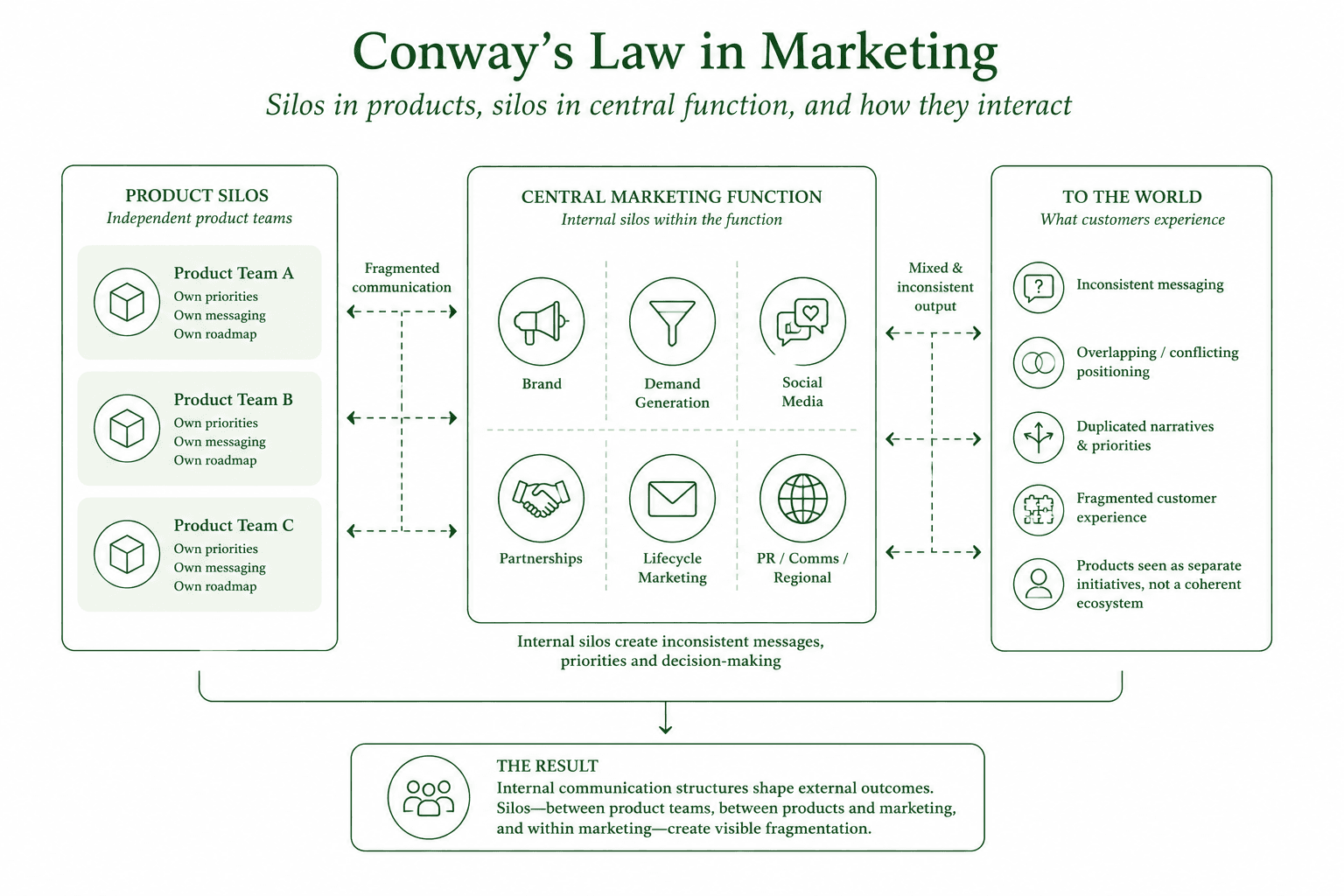
In a multi-product company, separate product teams can individually create excellent and genuinely useful products. But if those teams operate in silos (which is highly common) the external result often becomes fragmented.
Customers do not see internal org charts. They see disconnected messaging, inconsistent positioning, overlapping offerings, duplicated narratives, conflicting priorities, and products that feel like a collection of separate initiatives rather than a coherent ecosystem.
Even when every individual team performs well, the portfolio may still feel incoherent.
2. And in Centralized Marketing function
Adding a centralized marketing function can improve this situation, but it can also complicate it further.
Now communication no longer happens only between product teams themselves. It also happens between product teams and the central marketing organization. And if communication structures are weak, fragmented, or inconsistent, those fractures become externally visible as well.
What is especially interesting is that central marketing itself can become siloed internally. Brand, demand generation, social media, partnerships, lifecycle marketing, PR, regional teams: all may develop their own disconnected communication structures.
This fragmentation often becomes visible through marketing channels themselves.
Different channels start reflecting the teams behind them rather than the company as a whole: social media develops one tone, the website communicates another, lifecycle emails follow different priorities, while product marketing positions the same offerings differently again.
At that point, Conway's Law starts appearing on multiple layers simultaneously:
- between product teams,
- between product teams and central marketing,
- and within marketing itself.
Customers eventually experience all of it.
3. Conway's Law During Periods of Change
Conway's Law becomes especially visible during periods of rapid change.
Market disruptions, AI shifts (and following them chaotic creation of AI task forces across the organization), reorganizations, acquisitions, hypergrowth, leadership changes, new strategic priorities: all of these can sharply alter internal communication structures.
The problem is that organizational change usually happens faster than communication adaptation.
Teams get restructured. Ownership changes. Priorities shift. New dependencies appear. But if clear communication structures are not established quickly enough, the result often becomes externally chaotic.
This chaos becomes visible in inconsistent messaging, rapidly changing narratives, duplicated initiatives, unclear positioning, and fragmented customer experiences.
4. Vertical Conway's Law
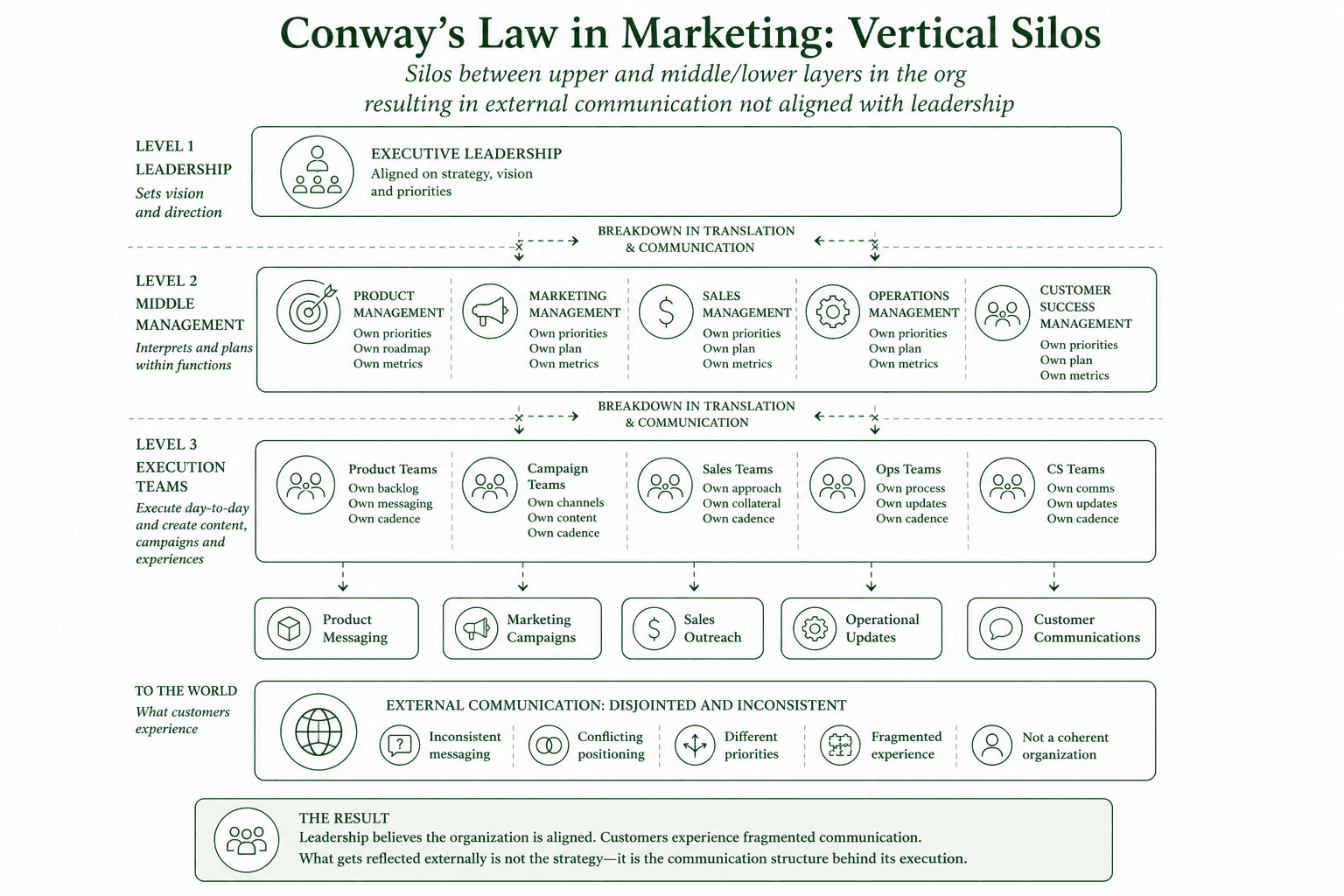
Conway's Law is not only horizontal. It is vertical as well.
Sometimes organizations achieve strong high-level alignment among leadership, but that alignment never properly translates downward into executional layers.
As a result, leadership may believe the organization is strategically unified while customer-facing implementation still remains chaotic.
Why?
Because customers do not care about executive alignment and join management board meetings. They experience the operational communication structures of the people actually building campaigns, writing content, launching initiatives, maintaining websites, producing assets, or interacting with customers daily.
What gets reflected externally is not the strategy itself. It is the communication quality surrounding the implementation of that strategy.
If priorities and goals are not transmitted clearly enough through the organization, fragmentation inevitably appears downstream.
5. Conway's Law and Brand Architecture
One of the most visible manifestations of Conway's Law in marketing appears in brand architecture.
Some companies feel like coherent ecosystems. Their products naturally connect with each other, share a recognizable language, reinforce a common identity, and create a sense of continuity for customers. Other companies, even highly successful ones, feel more like collections of separate products gathered under one corporate umbrella.
When product teams operate independently, with separate priorities, leadership structures, and communication flows, this fragmentation eventually becomes visible externally. Products develop different positioning, visual identities, and even different interpretations of what the company stands for.
Customers don't experience a unified ecosystem and instead experience multiple semi-independent organizations sharing the same logo.
This becomes especially visible in three brand-architecture patterns: a branded house (Apple), where every product ladders up to one master brand; a house of brands (Procter & Gamble), where each brand stands on its own by design; and a fragmented portfolio (Yahoo), where products accumulate without a coherent architecture. In a house of brands, the fragmentation is intentional and strategically aligned. In a fragmented portfolio, it is not — the company tries to present itself as a unified ecosystem while internally operating as disconnected teams.
That is why unified branding initiatives so often struggle. Companies try to fix fragmentation through rebranding, messaging frameworks, or visual identity systems, while the underlying communication structures remain fragmented.
Eventually, Conway's Law reproduces itself and the system gravitates towards new round of fragmentation.
| Yahoo — fragmented portfolio | Procter & Gamble — house of brands | Apple — branded house |
|---|---|---|
| Yahoo Mail | Tide | iPhone |
| Yahoo Messenger | Gillette | MacBook |
| Yahoo Answers | Pampers | iCloud |
| Flickr | Oral-B | Apple Music |
| Tumblr | Head & Shoulders | Apple TV |
| Yahoo Finance | Ariel | |
| Yahoo Sports | ||
| Yahoo News | ||
| Yahoo Search |
How to Address Conway's Law in Marketing
1. Counter-intuitive first step
The instinctive reaction is often: break silos.
But I don't think that should be the first step.
The first step should be understanding why the silos exist in the first place.
In many cases, silos are not accidental dysfunctions. They may exist for valid business reasons:
- scale,
- specialization,
- product complexity,
- regionalization,
- speed,
- technical expertise,
- or operational focus.
In large organizations, especially those growing rapidly, one fully integrated marketing team is often neither realistic nor efficient.
So before trying to remove silos, it is critical to study them carefully.
Understand why they exist and what are their goals, how they operate, and how communication actually flows between them.
Breaking silos and connecting silos are not the same thing.
The more important step is establishing strong communication structures between them.
2. Identifying the areas without ownership
And once you start examining these intersections, another pattern usually becomes visible: areas without clear ownership, usually existing between teams or departments.
These ownership gaps are often where fragmentation becomes most visible externally.
Some gaps are insignificant. Others are strategically critical. Some are clearly and immediately translate into customer-faced communication (content, positioning, structure of prices or discounts) and should be fixed urgently.
Identifying the important unowned areas and assigning clear responsibility for them is usually one of the highest-leverage improvements an organization can make.
3. Transparent communication
And finally: transparency.
Transparent communication structures dramatically reduce fragmentation. The more visibility teams have into priorities, dependencies, messaging, initiatives, and decision-making, the harder it becomes for disconnected narratives to emerge independently.
Conway's Law never fully disappears. But organizations can absolutely reduce how strongly it affects externally to sharing the information constantly and clearly.
4. The paradox
Solving Conway's Law completely may not actually be desirable.
Perfect organizational alignment often comes at the cost of speed, experimentation, autonomy, and innovation. The more synchronized and centralized communication becomes, the more coordination overhead appears. Decisions slow down. Teams become more dependent on approvals and consensus, which might be infinitely hard to achieve.
Some degree of fragmentation can therefore be healthy.
Independent product teams are often able to move faster, experiment more aggressively, and adapt more quickly to changing markets precisely because they are not deeply entangled in centralized rigid structures. Many highly innovative companies intentionally tolerate a certain level of inconsistency in exchange for speed and product autonomy.
The goal is not to eliminate Conway's Law. At scale, that's impossible.
The real challenge is balance: enough alignment for customers to experience one coherent company, but enough autonomy for teams to move fast and innovate without drowning in coordination.
AI helps polish the writing. The thinking, observations, and opinions are my own — drawn from working inside marketing teams.